Screen Time for Kids: Active vs. Passive (What Actually Matters)
If you’ve ever felt a pang of guilt watching your child stare at a tablet, you’re not alone. “How much screen time is too much?” is one of the most common questions parents ask. But after years of working with young children, we’ve come to believe that question is slightly the wrong one.
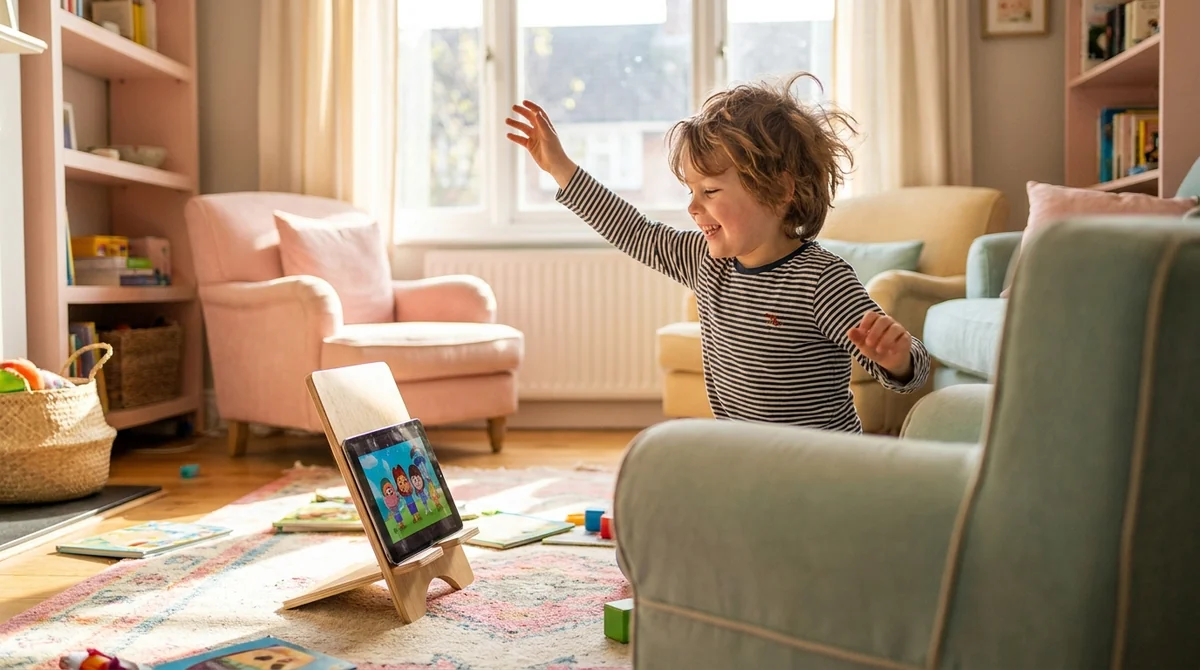
The better question is this: when your child is on a screen, are they sitting still and tapping — or are they thinking, moving, and doing? Because not all screen time is the same. And once you can tell the two apart, the guilt starts to fade.
Prefer to watch? Here’s everything in this article in two minutes:
The problem isn’t the screen — it’s sitting still
When people worry about screen time, what they’re usually picturing is a specific scene: a child slumped on the couch, eyes locked, body motionless, scrolling or watching for an hour. That image is the real concern. The body shuts down, attention narrows to pure consumption, and the child gets up tired and cranky.
This is passive screen time. The screen does all the work; the child just receives. Too much of it is genuinely worth limiting.
But there’s another kind of screen time that looks completely different — and lumping the two together is why so many parents feel stuck.
Active screen time: when the screen gets your child moving
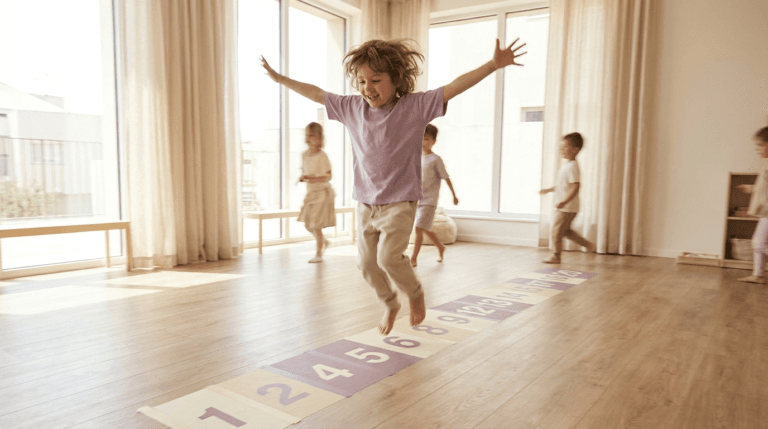
Imagine the same half hour, but now your child is standing up, jumping, counting out loud, solving a problem and then physically acting on the answer. The screen isn’t a babysitter here — it’s a coach. It prompts, the child responds with their whole body, and learning happens through movement-based learning.
This is active screen time, and it’s a fundamentally different experience for a developing brain. When the body is involved in learning, attention is higher, retention is stronger, and children actually enjoy it. The screen becomes a tool, not a trap.
The distinction matters because two children can both “have thirty minutes of screen time” and have two completely opposite experiences. One ends up drained; the other ends up engaged and having practiced a real skill.
What the experts actually recommend
Here’s something that surprises a lot of parents: the leading health authorities have quietly shifted away from counting minutes alone.
The American Academy of Pediatrics (AAP) now emphasizes quality, context, and conversation over a single magic number. Its core guidance: avoid screens (other than video chatting) before about 18 months, introduce only high-quality content with a caregiver from 18–24 months, and aim for around one hour of high-quality programming per day for ages 2–5. Beyond that, the AAP’s bigger message is to make sure screens don’t crowd out the things young kids need most — physical play, family time, and sleep.
The World Health Organization (WHO), in its guidelines for children under five, is more specific on time: no sedentary screen time for children under 2, and no more than one hour per day (less is better) for ages 2–4. Just as importantly, the WHO frames screens inside a bigger picture — children over one should be physically active for at least three hours spread across the day.
Notice what both have in common. The headline isn’t really “screens are bad.” It’s “kids need to move, play, and engage — and screens become a problem mainly when they replace that.” Which brings us right back to the active-versus-passive distinction.
The science: why movement makes learning stick
This isn’t just a feel-good idea. A growing body of research in embodied cognition — the study of how the body shapes thinking — shows that movement and learning are deeply linked.
The basic finding is that our sensorimotor systems, the networks that connect sensing and moving, strongly shape how we think and remember. When children learn through physical action — forming a shape with their body, acting out an idea, manipulating objects — they encode the information more deeply than they do through passive watching. Studies have found embodied learning can outperform sitting-and-listening for teaching young children new vocabulary, and that adding meaningful movement to lessons has some of its largest effects on memory.
For math specifically, the research is encouraging: physical activity tied to academic content can improve learning and, importantly, never seems to hurt it — while also boosting motivation and engagement. In plain terms: a child who jumps to the answer remembers the answer better than a child who taps it.
Screen time by age: a quick parent guide
Every child is different, but here’s a simple framework that lines up with current AAP and WHO thinking:
- Under 18 months: Skip screens apart from video calls with family. Babies learn from faces, voices, and floor play.
- 18 months – 2 years: If you introduce screens, choose high-quality content and watch together, talking about what you see. Co-viewing is the key word.
- Ages 2–5: Aim for roughly an hour a day of high-quality content — and favor the kind that asks your child to do something, not just watch. Active screen time can do double duty here.
- Ages 5–9: Time limits matter less than balance and content. Make sure screens aren’t displacing physical play, sleep, family meals, or homework — and lean toward apps that get your child thinking and moving.
The thread through all of it: protect movement, sleep, and connection first; then the screen time that’s left is far easier to feel good about.
How to tell active from passive
You don’t need an app to audit. Just watch your child for a minute and ask:
- Is their body moving, or completely still? Movement is the clearest signal.
- Are they making choices, or just receiving? Active content asks the child to decide, try, and try again.
- Do they get up energized or foggy? How they feel afterward tells you a lot.
- Could they explain what they just did? If they learned something, they can usually show you.
If most answers point to “still, passive, foggy,” that’s the screen time worth trimming. If they point to “moving, choosing, energized,” that’s screen time doing some good.
How to turn passive screen time into active screen time
You don’t have to throw out the tablet. Often you can shift the same device toward something more active:
- Swap watch-only for do-along. Trade a passive cartoon for content that prompts your child to jump, dance, count, or answer out loud.
- Add a body to the task. Pause a show and have your child act out what just happened, or turn a counting app into a “jump to the number” game.
- Co-play, don’t just hand off. Sit in for a few minutes, ask questions, and turn it into a shared activity rather than a solo screen.
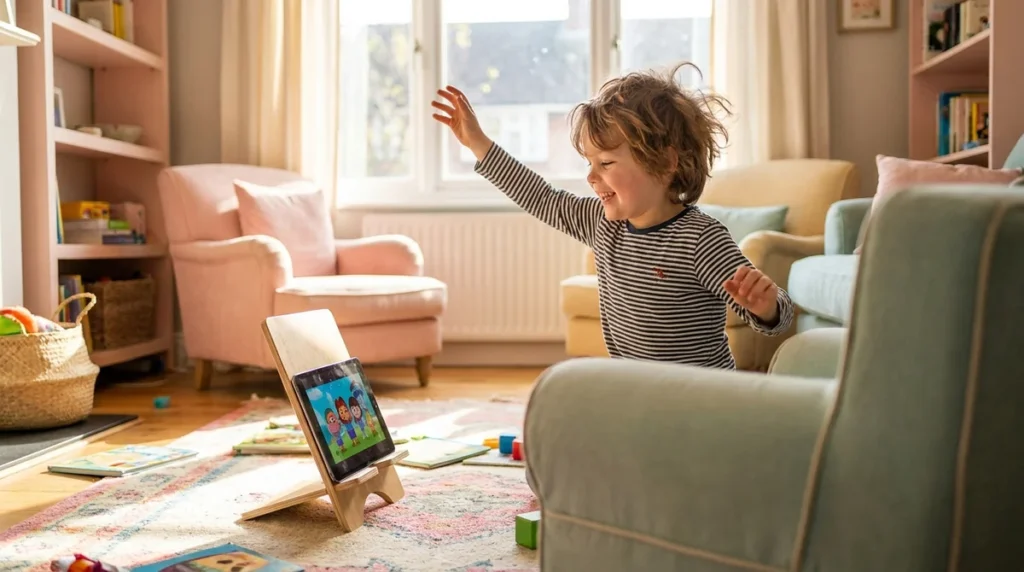
- Move the screen, move the kid. Prop the phone up and let your child play standing up, with room to move, instead of curled on the couch.
A few simple rules that actually help
You don’t have to ban screens to parent well. A few flexible habits go a long way:
Set a limit, but stay flexible. A rough daily cap helps, but treat thirty minutes of active, educational use differently from thirty minutes of passive scrolling. They’re not equal, so they don’t have to share the same budget.
Choose content that asks something of your child. Favor apps and shows that make your child think, move, or respond — not just watch. If you want ideas, here are 15 active learning activities kids actually love.
Sit with them sometimes. Screen time doesn’t have to be solitary. Asking “what are you doing?” turns a screen into a shared activity and lets you see the content yourself.
Balance the day, not just the screen. A child who’s been running, building, and playing outside can handle a bit of screen time far better than one who’s been sedentary all day.
Where ActiveMinds comes in
We built our app, Hoppy Math, around exactly this idea: screen time that gets kids up instead of keeping them down. Using your phone’s camera, your child solves real math by moving their whole body — jumping to answers, forming shapes, racing to numbers. It’s built on kinesthetic learning, there’s no extra hardware, and it’s ad-free.
It’s our answer to the screen-time guilt: the screen is still there, but now it’s the thing pulling your child off the couch instead of pinning them to it. Active screen time, made simple. Download Hoppy Math on the App Store or get it on Google Play — free to start.
Frequently asked questions
How much screen time is OK for my child?
It depends on age and content. The AAP suggests around an hour of high-quality content a day for ages 2–5, and the WHO recommends no more than an hour for ages 2–4. For older kids, balance matters more than a strict number — as long as screens aren’t replacing play, sleep, and family time.
Is all screen time bad?
No. Passive screen time — sitting and watching — is the kind worth limiting. Active, interactive screen time that gets your child moving and thinking can actually support learning.
What counts as “active” screen time?
Anything that asks your child to respond with their body or mind: moving, choosing, solving, creating. If your child is physically involved and making decisions rather than passively receiving, it’s active.
How do I cut back on passive screen time without a fight?
Replace rather than remove. Swapping a passive show for something active or hands-on is usually easier than taking the screen away entirely, because your child still gets to use the device — just in a better way.
Does screen time really affect learning?
The content and the body matter. Research on embodied cognition shows children learn and remember better when movement is part of the process — which is why active screen time can be a genuine asset, not just a guilty compromise.
If the question was never really “how many minutes,” but “what is the screen doing to my child” — this is the kind of screen time you can feel good about.